



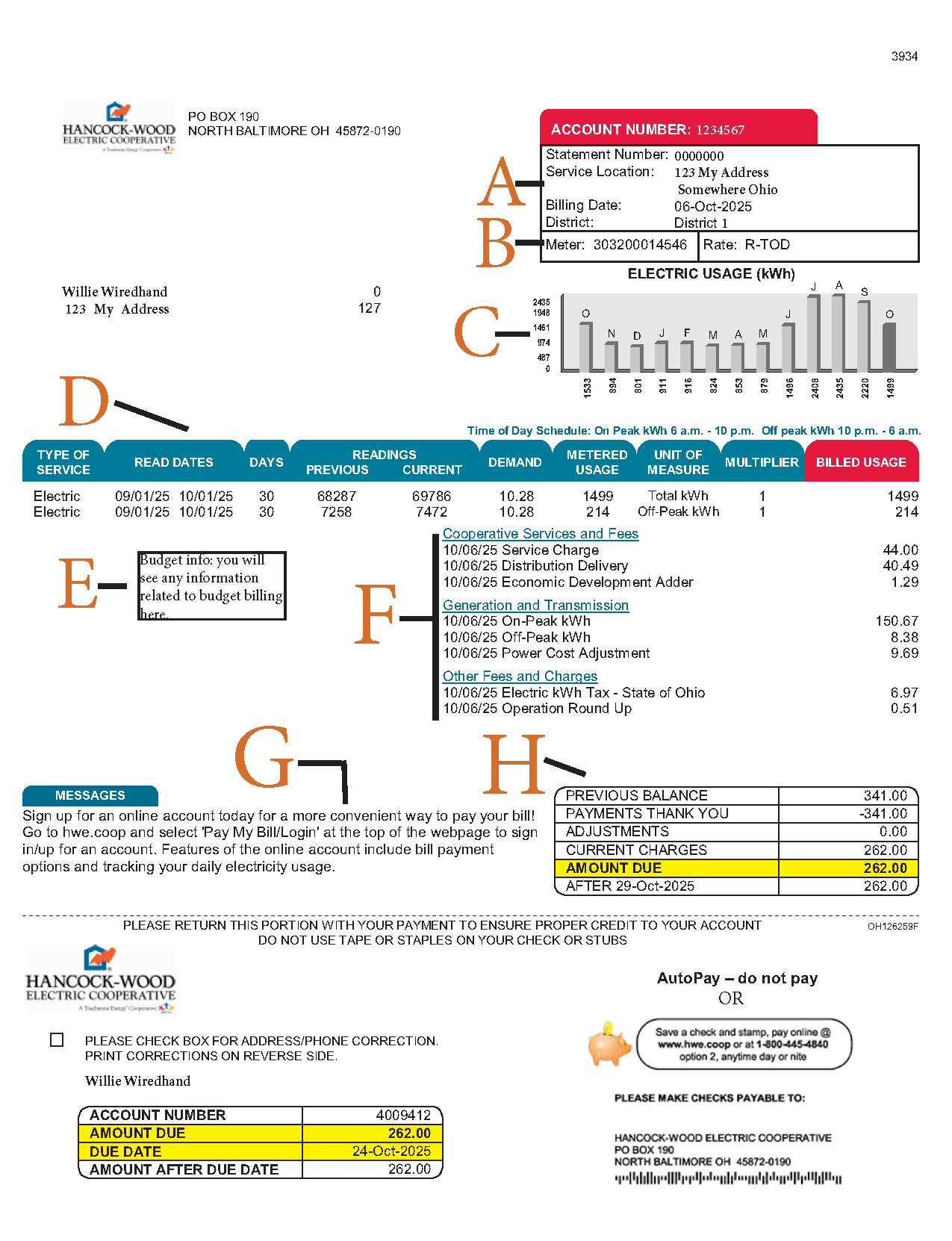
Understanding your Hancock-Wood Electric bill:
A- Your account number, statement number, service location district number, billing date & board district.
B - This indicates your meter number and rate classification.
C - Your 13-month usage history to help you better watch trends and electric consumption.
D - Your meter reading section:
- Type of Service - Listed as "Electric Service"; however, on security light-only accounts this column will be blank.
- Read Dates - The beginning and end dates for the billing period.
- Days - The total amount of days in this current reading cycle.
- Reads - The previous and current meter dial readings.
- Metered Usage - The amount of electricity you consumed during this reading cycle, measured in kWh (kilowatt hours).
- Unit of Measure - Measured in kWh (kilowatt hours).
- Multiplier - In most homes the meter multiplier is 1. Monthly electric use may be more than the meter can register on some accounts, so there could be a multiplier" labeled on the front, which is usually 40, 80, or more. You then multiply the kwh metered usage by the multiplier to get the total billed usage.
- Billed Usage - The amount of electricity you are being billed for during this reading cycle.
E - Budget message - If you are on budget billing, this message (with your current information) appears on your bill each month.
F - Your charge details / breakdown of charges:
- Cooperative Services and Fees - This component allows us to generate sufficient revenue to cover our fixed costs. Fixed costs are those that we incur annually no matter what, such as interest and principal on long term debt, insurance, employee wages and benefits, equipment, trucks, tools, and rebuilding of the distribution system, to name a few. The Economic Development Adder is utilized to invest in our local community, with the objective of increasing sales for the cooperative to stabilize electric rates for our members.
- Generation & Transmission Charge - The Power Cost Adjustment or PCA is a charge or credit that reflects increases or decreases in the utility's actual cost of purchasing or producing electricity. The PCA helps ensure customers pay the current cost of power without requiring the utility to file a full rate case each time wholesale energy prices change. On-Peak and Off-Peak kWh information can be found here. Interested in learning more about time-of-day rates and what the on-peak hours are click here.
- Other Fees and Charges – This includes the required State of Ohio kWh tax and can also include Operation Round Up your (bill was automatically rounded up to the next highest dollar, and that amount is then deposited into a separate account. These funds are used as charitable contributions to qualifying community groups and individuals in our area needing assistance), security lights, load control credits, etc.
G - Messages - We share important messages here, so be sure to read this area each month.
H - Account Summary